MT. KILIMANJARO NATIONAL PARK
TANZANIA
- Your African Safari Dream.
Your African Safari Dream.
Your African Safari Dream.
Your African Safari Dream.
- Your African Safari Dream.
|
Tanzania is a land of Immense Natural beauty undiminished through centuries of man’s habitation. The United Republic of Tanzania Covers an area of 945,087 sq. km. of this 247,537 sq. km is protected wildlife area (including 61,000 sq. km. Of inland water) making it four times the size of the United Kingdom, or equal to the combined size of France, Belgium and Germany or over twice the size of Sweden. The population of Tanzania is 32.9 million of which 920,000 people leave in the islands of Zanzibar and Pemba. To the Holiday maker Tanzania is a PARADISE waiting to be discovered. It offers unique varieties of attractions that appeal to all generations; the landscape, the white sand beaches, the National Parks teeming with wildlife, the sun, and the friendliness and warmth of the people invite you at all seasons. |
GAME PARKS AND RESERVES
|
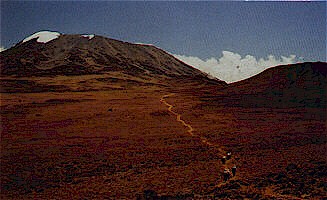
MT. KILIMANJARO NATIONAL PARK |
|
| T he park was established in 1973 and
officially inaugurate in July, 1977. It covers an area of 756 sq. km. Most of which is
above the tree line at 2700m. above sea level. Mount Kilimanjaro is the highest mountain
in Africa, the free standing mountain in the world and one of the largest volcanoes ever
to have burst through the Earth’s crest. Its complex has an enormous base of about 50
x 80 Km. It rises from the dry plains through the wide belt of forest and high alpine zone
of heath to an almost bare desert and finally to the snow cap at an altitude 5,895m above
sea level. The mountain can be, climbed any time of the year although it is often wet in
the rain forest during the rainy season in April and May. The best period is from August
to November. |
|
ARUSHA NATIONAL PARK. Located just 37 Km away from Arusha, this is the second smallest Park in Tanzania after the Gombe stream National Park. It has a total area of 137 sq. km. Established in 1960, is the only park which has had changed its name three times. Initially it used to be called the Ngurdoto Crater National Park. By then, the prominent features included the Momella Lakes. When Mount Meru Crater was annexed, the name changed to Meru Crater National Park. Later the name Arusha National Park was adopted. However it has been suggested that when the entire natural habitat above the eighteen hundredth contour line is included in the Park, the name should rightly settle as Mount Meru National Park. Major attractions include the Momella Lakes, Ngurdoto Crater, Meru Crater and Cone as well as the rare black and white colobus monkeys with its stub tails, Elephants, Buffalo, Bush buck, Giraffe and Red forest duiker. |
|
NGORONGORO CRATER. |
|
| Ngorongoro Crater standing at 2,236 m. above
sea level, is the largest unbroken CALDERA in the world. Surrounded by very steep walls
rising 610 m. from the crater floor, this natural amphitheater measure 16-19 miles across
in diameter and has an area of 259 sq. km. On the floor of this Garden of EDEN which can
be reached by 4 x 4 wheel drive vehicles, roam hundreds of thousands of plain animals,
elephants, buffalo, zebra, wildebeest, gazelle rhino, velvet monkey and the very hungry
predators, including cheetah, hyenas and black manned lion. Ostriches, Kori bustards,
secretary birds, crested cranes, agrets red billed ox-packers and the countless flamingos
at the soda lake can be observed. |
SERENGETI NATIONAL PARK. The name Serengeti is derived from the MAASAI word "SIRINGET" meaning endless plains and sums up emotion felt by the visitor when contemplating nature at its wildest. This park covers a vast area of over 14,763 sq. km. stretching from the highland plateau of Ngorongoro in the South to the Mountainous slopes of ISURIA in the North to Lake Victoria the West. About 35 species of plain animals can be observed including the "Big Five" - Elephant, Rhino, Lion, Leopard and Buffalo and cheetah the fastest animal in the world. At full speed cheetah can run 65km or 40 miles an hour and can leap as for as seven metres 23 feets a distant equal to five times the length of the animals body not forteting the herds of wildebeest, gazelle and zebra which in late May or early June depending on the weather, begin their spectacular MIGRATION from the central plains to the permanent water in the North. Lines and columns of wildebeest up to 40 km. long have been observed. The best months for visiting the park are from December to February and May to July. |
|
LAKE MANYARA NATIONAL PARK. This 325 sq. km. park shelters under the massive escarpment of the Rift Valley and consists of five distinct vegetation zones with a wide range of Flora and Fauna. The park is famous of its tree climbing LIONS that laze on the branches of acacia trees during the day. It has over 350 species of wild birds, the most profuse and lively being the Flamingo; (lesser and greater) pelican and sacred Ibis, grebe and stork can be observed. (The bird watcher’s paradise). The park is also home to large herds of buffalo, elephant, leopard, hippo, antelope, monkeys and baboons. At the Southern end of the park are Hot sulfur springs (600C.) called MAJIMOTO. |
SELOUS GAME RESERVE. The Selous, occupying an enormous Land area of 55,000 sq. km. is the largest Game Reserve in Africa. The reserve is one of the Africa’s greatest wilderness where the forest and bush are untamed and the animals unmolested by man. It contains some of the largest Elephant in Africa as well as vast numbers of wildlife. Safari Camps including Rufiji River Camp, Beho Beho Camp, Stiegler’s Gorge Camp and Mbuyu Safari Camp, provide comfortable Accommodation. It’s only in the Selous that one can have game drive, Boat and walking safaris together. The reserve is inaccessible during the rainy season - March to May due to floods. The best time to visit the reserve is from June to October. |
OLDUVAI GORGE. Between the great wildlife sanctuaries of Ngorongoro and Serengeti lies "Olduvai gorge" the Cradle of Mankind". In 1959 Prof. Louis Leakey unearthed the skull of the NUTCRAKER man or "Zinjanthropus Boisei" whose skull is in the Museum in Dar es Salaam. Nearby is the Laetoli, where the footprints of hominoids (said to be over 3.5 million years old) were discovered by Mrs. Leakey in 1979. To the North is Oldoinyo Lengai a living volcano. Archeological work is still going on this area. The theory exists that Homo Sapiens originated in Africa and Olduvai Gorge provides the evidence |
|
TARANGIRE NATIONAL PARK. Tarangire National Park is situated 120 km. from Arusha and South East of Lake Manyara National Park. This park is famous for its dense wildlife population which is most spectacular between June and December. During this time animals migrate from the dry Maasai steppe to Tarangire River looking for water. Among other species to be seen are Rhino, buffalo, elephant, lion, warthog, eland, the fringe eared oryx, lesser and greater Kudu, gernuk and large number of impala. Day trips can be organized from Arusha to this park. |
|
MIKUMI NATIONAL PARK. Situated some 300 km. South West of
Dar-es-Salaam at an altitude of 550 m. covers an area of 3,230 sq. km. This park offers a
variety of wildlife - baboons, buffalo, colobus monkey, African hunting dog, eland,
elephant, giraffe, hartebeest, hippo, impala, sable antelope, warthog, water buck,
wildebeest, zebra, greater kudu and the predator leopard and lion can be seen in all
seasons. Over 300 species of birds have been observed in the park some of which are
Eurasian migrants that are present from October to April. |
|
UDZUNGWA MOUNTAINS NATIONAL PARK. Udzungwa Mountain National Park is a newly established Conservation area of about 1,000 sq. km. Covering the Mwanihana Forest Reserve in the Morogoro Region and the West Kilombero Scarp Forest Reserve in the Iringa Region. The Udzungwa Forest which forms part of the Park, many rare plants have been identified, not found anywhere else in the world. The Park support a Large number of game including Elephants Buffalo, Lion, Leopard, Sable antelope and Primates. The Park is about 10 Kms. from Mikumi National Park. |
DAR ES SALAAM. Dar es Salaam - "Haven of Peace" - is one of the most informal and relaxed cities in the world. Essentially African in character and an ideal centre for holiday in Tanzania, Dar-es-Salaam is the starting point for Tanzania’s "Southern Circuit" embracing wildlife viewing in the Selous, Ruaha and Mikumi, beach holiday, big game fishing and visit to Zanzibar and Mafia Islands. Dar es Salaam is the country’s chief port and commercial centre. |
|
MAFIA ISLAND. Only 40 minutes flight South of Dar es Salaam is one of the most exciting Big Game fishing and diving location in the world. The virtually unfished waters off the Island abound with rich variety of fish of tremendous size and weight many of them being great fighters. Catches include marlin, sailfish, shark, kingfish, barracuda, snapper, rock cod, dolphin, horse mackerel, wahoo, five finger jack and fimbo. The main fishing season is from September to March. Mafia Island Lodge offers 40 comfortable rooms with air conditioning, with sea view and facilities for underwater diving and "Safaris" along the coast and to neighbouring Islands. |
|
BAGAMOYO. 75 km. North of Dar es Salaam is the former capital of Tanganyika and chief sea port. Bagamoyo once a notorious embarkation port for slave trade, reminders of which can be seen in the shape of shackle rings, stone. Bagamoyo is said to mean "Here I lay down my Heart", a cry of desperation by slaves before they where packed aboard vessels for their voyage into captivity. About 5 km to the South, at KAOLE are ruins of coral mosque as well as graves and houses dating back to the late 13th century. |
|
RUAHA NATIONAL PARK. Covering 13,000 sq. km. this relatively new and undisturbed park is Tanzania's third largest park and also largest elephant sanctuary. It lies 130 km. West of Iringa. It’s name derives from the great RUAHA RIVER which flows along its entire eastern border creating spectacular gorges and scenery. Hippo, Crocodile, turtle and fish inhabit the river. The Park is also known for its concentration of lesser and greater Kudu, Roan and sable antelope. The bird life is also very interesting and varied over 370 species some of which are not found in the Northern circuit. The best months for game viewing are July and November. |
|
ZANZIBAR. Set like a Jewel in tranquil coral waters only 20 minutes flight from Dar es Salaam is one of the World’s most beautiful Islands. Zanzibar its name evokes romantic past. To the shores of this Island came summarians, Assyrians, Hindus, Egyptians, Phoenicians, Southern Arabians, Chinese and Malays. From these shores the great European Explorers - Burton, Speke, Livingstone, Krapf, Rebman and Grant set out on their "Voyage of Discovery" into the hinterland. The different races that have settled in Zanzibar over the centuries have left impact on the people - religions, cuisine culture and architecture are but few. Today visitors can visit the "House of the Wonder" (one of the Palace of former Sultan) walk the narrow streets of the old stone town, visit the Persian Baths, the old slave market, Prison Island and World war shrines. The extensive white-sand beaches, fringed with palm trees that whisper in the tropical breeze offers virgin Holiday destination yet to be discovered.
|